
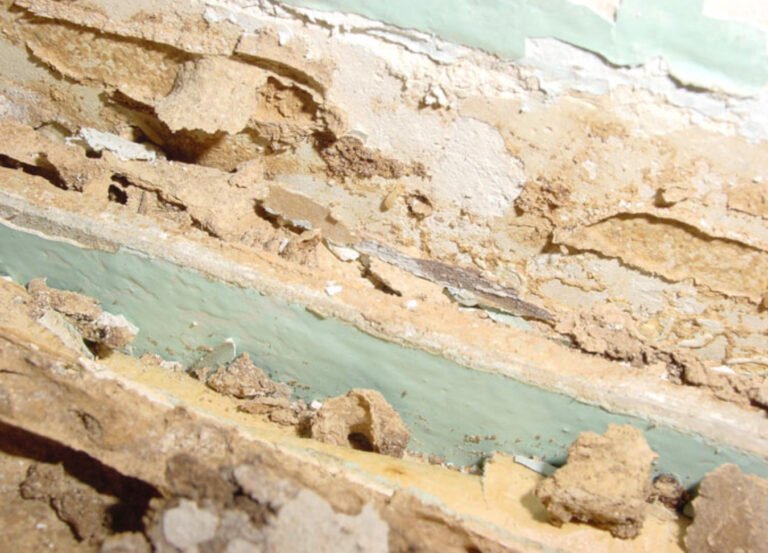
In a house, termites can quietly damage the framing, floors, door and window frames, or other cellulose-containing materials, sometimes for a long time before their presence is discovered. As a result, some of the damage can progress inside the wood without being immediately visible on the surface.
This stealth is their main strength. By the time an infestation is finally detected, the damage is often already extensive.
Would you like to understand how termites live and why they go unnoticed so easily? Check out our comprehensive guide to termites.
Key Takeaways
- Termites mainly work inside the wood.
- They move along in the dark.
- Subterranean termites do not produce the sawdust typical of certain other wood-boring insects.
- The first visible signs of damage often appear late.
Damage that could affect many buildings
Termites can infest various types of buildings as long as they find cellulose-containing materials and suitable entry points. But regardless of the area in question, one thing remains the same: they can carry out their activities in the ground or inside materials without being immediately noticeable.
To understand their distribution across the country, see our report on the presence of termites in metropolitan France and the overseas departments and regions (DROM).
Termites are hard to detect
As invisible enemies, termites move about in the dark and cause damage inside buildings that is particularly difficult to detect from the outside.
For example, they can damage a baseboard while leaving only the thin layer of paint on the surface intact. Visually, the baseboard appears to be in good condition… until it crumbles under the slightest pressure.
Subterranean termites burrow tunnels and pockets inside wood without producing the sawdust typical of many wood-boring insects. The absence of visible debris thus makes their activity difficult to detect.
However, certain clues may eventually become apparent. To learn how to recognize them, check out our feature on Signs of Termite Infestation.
Termites and the Damage They Cause, Which Is Often Invisible
Yes, termites often cause damage that isn’t visible. They continue to spread out of sight, sometimes to the point of seriously weakening a home. Roof frames, floors, door and window frames, baseboards, and staircases can be affected, as well as materials that they do not directly consume.
To reach a source of cellulose, termites may also travel through or around certain materials that they do not consume directly. Damage or signs of their presence are therefore not necessarily limited to wooden items alone.
This ability to spread unnoticed explains why an infestation is often discovered only after it has reached an advanced stage.
Why does the damage remain hidden for so long?
Unlike other wood-boring insects, termites hollow out wood from the inside while leaving a thin outer layer intact. As a result, a beam, baseboard, or door frame may appear perfectly intact even though its structure has already been severely weakened.
It is precisely this characteristic that makes them so difficult to detect.
Why does termite damage often go unnoticed?
| What we observe | What’s Really Going On |
| One baseboard appears to be undamaged. | Termites may have completely hollowed out the inside of it. |
| A beam appears to be sturdy. | The wood is gradually being eaten away from the inside. |
| No characteristic signs of woodworm. | Subterranean termites do not produce the typical waste products found in many other wood-boring insects. |
| No insects in sight. | Termites live in the soil or inside wood, away from light. |
Why does monitoring help limit the risk of significant damage?
Since termite activity can go unnoticed for a long time, monitoring the building makes it possible to detect their presence earlier and avoid discovering the problem only after damage becomes visible.
This vigilance is particularly recommended in areas subject to a prefectural order or where an infestation has already been reported nearby.
Would you like to know if your municipality is affected? Check out our map of termite infestations in France.
Appropriate monitoring to minimize damage
When a preventive approach is appropriate, a monitoring system can be used to regularly check for activity around the building. The Sentri Tech method uses stations installed around the perimeter of the house and monitored over time; if termite activity is detected, the treatment plan can then be adjusted accordingly.
Learn more about our preventive termite treatment.
Would you like to have your situation reviewed? Find a Authorized Sentri Tech Applicator near you.
Frequently asked questions
Why do termites cause so much damage without being detected?
Because they live mainly in the soil or inside wood. They dig tunnels, often leaving a thin surface layer intact, which gives the impression that the materials are still in good condition even though their structure has already been weakened.
Do termites produce sawdust?
Subterranean termites do not produce the sawdust typical of many wood-boring insects. This lack of visible residue helps make their activity particularly inconspicuous.
What are the first signs of an infestation?
Several signs may catch your attention, but none on its own is enough to confirm an infestation. Find detailed descriptions of these signs in our article on signs of termite infestation.
Do termites only destroy wood?
No. Termites seek out the cellulose found in wood, cardboard, or paper. To reach it, they can pass through other materials, such as drywall, certain types of insulation, or utility ducts, without actually consuming them.
How can we minimize the risk of significant damage?
Early detection of termite activity allows for intervention before the damage becomes more severe. Depending on the building’s condition, regular monitoring can therefore be a useful preventive measure.
In summary
- Termites mainly work inside the wood, away from light.
- Subterranean termites burrow tunnels in wood without producing the sawdust typical of many other wood-boring insects.
- The initial damage often remains invisible for a long time.
- An infestation is often discovered when the affected items are already weakened.
- Regular monitoring allows you to take action before the damage becomes significant.