
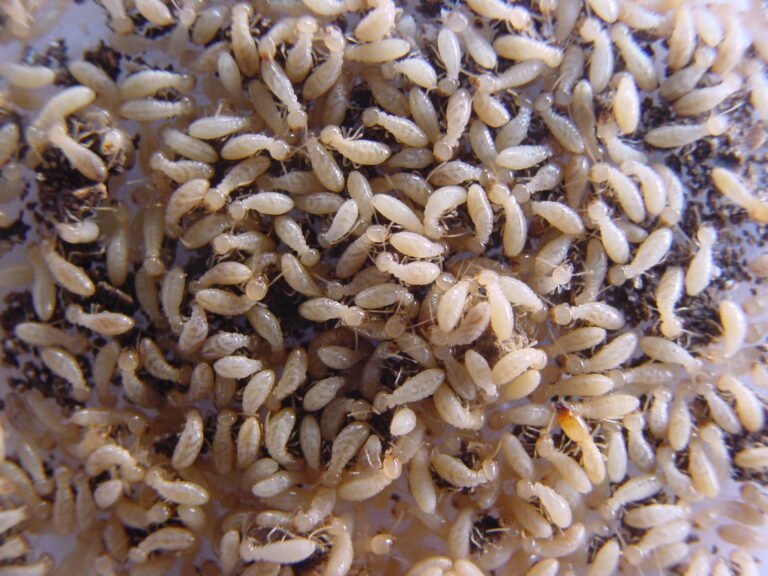
Like ants and bees, termites are social insects that live in colonies. Invisible most of the time, they live underground or inside wood, where each individual performs a specific role. This organization explains their remarkable efficiency… but also the damage they can cause when they infest a home.
Who are termites, really? How can you tell the different members of a colony apart? And why does their way of life make them so hard to detect? That’s what we invite you to discover.
Key Points
- Termites live in organized colonies.
- Each caste has a specific function.
- The workers are responsible for feeding the entire colony.
- The soldiers are defending the settlement.
- The queen ensures egg-laying and the colony’s growth.
Who are termites?
The termites found in France belong primarily to the genus Reticulitermes and live underground. With the exception of winged reproductive individuals during the swarming season, they avoid light and move discreetly through the soil or inside wood.
Although they are often called “white ants, ” they are not actually ants. Even though their social organization resembles that of ants or bees, they belong to a different group of insects.
This inconspicuous lifestyle explains why their presence often goes unnoticed until the first signs of damage appear.
Why are they so hard to detect?
Termites do not live in the open air. They move through a network of underground tunnels or inside wooden structures, where they are protected from light and drying out.
It is this stealthiness that explains why infestations are often discovered late.
Want to know the early signs of an infestation? Find out what signs should put you on alert.
How can you tell the different types of termites in a colony apart?
A colony consists of several categories of individuals, known as castes. All contribute to the colony’s survival and development, but each has a distinct role and characteristics.
The main individuals in a termite colony
| Individuals | How can you tell them apart? | Their role |
| Workers | White, small in size, very numerous. | Search for cellulose, feed the colony, and maintain the tunnels. |
| Soldiers | Large head and powerful jaws. | Defend the colony against predators. |
| King | Brown, wingless after mating. | Ensure reproduction with the queen. |
| Queen | Very large abdomen; unable to move. | To lay several thousand eggs a year and ensure the colony’s growth. |
| Neotenic | Secondary adults with small wing buds. | To allow for the establishment or maintenance of new colonies under certain conditions. |
The Workers: The True Architects of the Colony
They are the ones responsible for the damage seen in homes. Small, whitish, and making up the vast majority of the colony, worker termites are constantly active. They tirelessly travel through the tunnels in search of cellulose found in wood, cardboard, or paper.
Their role is not limited to feeding themselves. After consuming cellulose, they digest it and then redistribute it to other members of the colony through a process called trophallaxis. Larvae, soldiers, the king, and the queen are thus directly dependent on their activity.
Would you like to learn more about the role of worker termites and trophallaxis? Check out our page on the lifestyle of termites.
Soldiers: The Guardians of the Colony
Fewer in number than the workers, soldiers are easily recognizable by their large heads and powerful mandibles. Their sole mission is to defend the colony against predators, mainly ants.
On the other hand, this specialization prevents them from feeding themselves. They are entirely dependent on the workers, who provide them with food through trophallaxis.
The King and Queen: At the Heart of the Colony’s Development
Contrary to popular belief, a colony does not depend solely on a queen. It is led by a breeding pair, consisting of a king and a queen.
After mating, the king loses his wings and remains with the queen for the rest of his life. The queen’s abdomen gradually grows until it becomes very large, allowing her to lay several thousand eggs each year.
Unable to provide for themselves, the king and queen are fed and cared for by the workers, on whom the entire colony depends.
How does a new colony form?
Every year, usually between January and April, some of the winged breeders leave the colony in a phenomenon known as swarming.
After they take flight, the surviving individuals form pairs. If conditions are favorable, they can settle in a suitable environment and establish a new colony.
However, not all breeding pairs succeed: only a few find a suitable place to settle.
Neotenic species: a more discreet form of reproduction
Once the colony has developed sufficiently, secondary breeders, known as neotenic individuals, may appear. Measuring about 5 to 6 mm, they have small, underdeveloped wings and are capable of reproducing without leaving the colony.
This method of reproduction, sometimes called propagation by cuttings, can in particular facilitate the spread of termites when soil or debris that already contains termites is moved.
Learn More About Termites to Fight Them More Effectively
Understanding who termites are helps us better grasp why they are able to quietly infest a home for several years. Their colonial organization, the division of roles among the different castes, and their mode of reproduction largely explain their remarkable ability to adapt.
Being able to identify workers, soldiers, the king, the queen, and even neotenic individuals also helps us better understand how an infestation works and the importance of early intervention.
Do you think you’ve spotted a pest infestation? Find the nearest certified Sentri Tech applicator near you.
Frequently asked questions
Are termites white ants?
No. Termites are sometimes called “white ants” because of their light color and their colonial lifestyle. However, they belong to a different group of insects than ants.
What is the role of the queen in a termite colony?
The queen is responsible for laying the eggs that will allow the colony to grow. Nourished by the workers, she can lay several thousand eggs each year, depending on the species and the colony’s stage of development.
Why are worker termites the most destructive?
Because they are constantly searching for cellulose to feed the entire colony. They are the ones who dig tunnels and cause most of the damage seen in buildings.
What is the purpose of neoteny?
Neotenic bees are secondary breeders capable of reproducing when certain conditions require it. They can help establish or maintain a colony without swarming.
Can you see termites with the naked eye?
Yes, but it’s quite rare. Termites generally live away from light, in the soil or inside wood. The ones you see are most often winged reproductive termites during swarming or termites uncovered during construction work.
Key takeaways
- Termites live in organized colonies where each individual performs a specific function.
- The workers forage for cellulose, maintain the tunnels, and feed the entire colony.
- The soldiers provide defense, while the king and queen ensure reproduction.
- Neotenic individuals represent another form of reproduction that enables the development of new colonies.
- Termites’ stealthy nature explains why an infestation is often discovered too late.