
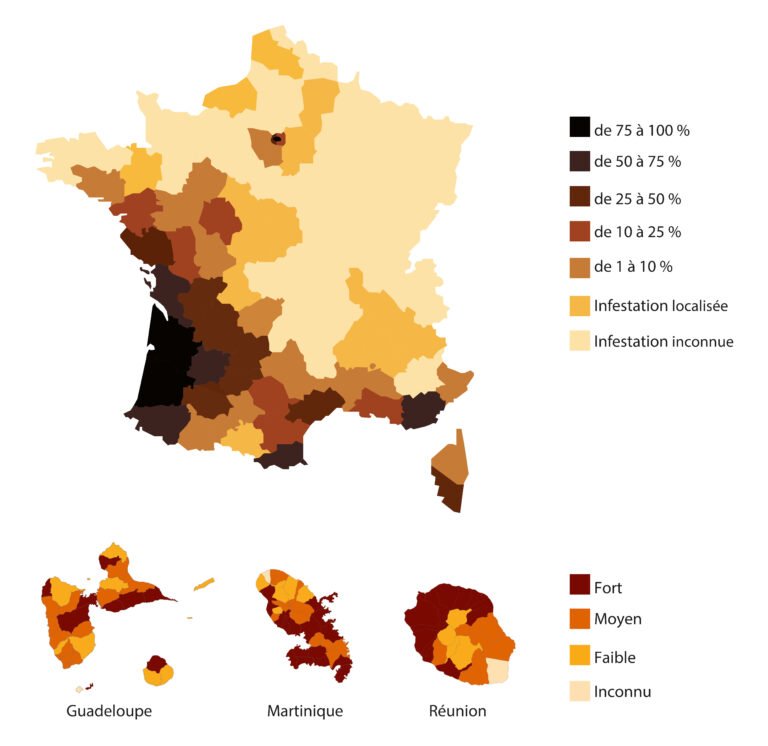
Termites are now present in many regions of France, but their distribution is uneven. When infestations are identified, a prefectural order defines the areas that are infested or likely to become so in the near term. On this page, we use the term “termite risk areas” to refer simply to the territories covered by this zoning.
Understanding this classification helps determine whether a municipality is affected, interpret the termite map of France correctly, anticipate certain obligations when selling a property and, above all, assess the risk to a home more accurately.
Key points to remember
When one or more termite infestations are identified, the prefect may issue an order defining areas that are infested or likely to become so in the near term. This zoning may cover all or part of a territory and can change as new infestations are identified. Being located within a designated area does not mean that a property is infested: the classification applies to the territory, not to each individual building.
Why has France defined termite risk areas?
Termites live in the soil and gradually spread from one area to another over time. Their progression does not stop at municipal or departmental boundaries. Once a colony becomes established, it can weaken the wooden elements of a building before the first signs of damage become visible.
In response to this biological reality, public authorities have introduced a zoning system. When termite infestations are identified in one or more municipalities, a prefectural order defines the areas that are infested or likely to become so in the near term. This system helps keep property owners better informed, sets the framework for certain regulatory obligations and allows preventive measures to be adapted to local conditions.
To understand the legal basis for this system, you can consult our guide to prefectural termite orders, as well as the provisions of the French Construction and Housing Code relating to termite control.
A classification designed more to protect than to alarm
The classification of a municipality as a termite risk area can sometimes be perceived as a cause for concern. In reality, it is primarily a preventive measure designed to limit the spread of termites and better protect buildings and property.
Being located in a classified municipality does not mean that a house is infested. Conversely, a building may occasionally contain termites even before a prefectural order has been issued. Zoning therefore makes it possible to take action earlier, based on local observations, rather than waiting for infestations to become widespread.
- If you would like to know how termites can be detected before damage becomes visible, see our guide to the warning signs to look out for.
A system established under French regulations
The classification of municipalities is governed by the provisions of the French Construction and Housing Code relating to termite control.
When a termite infestation is identified, the prefect may issue an order defining the areas concerned in order to organise preventive measures, inform property owners and enforce the obligations set out in the regulations.
To understand the legal framework as a whole, see our guide to termite regulations in France, as well as the relevant provisions of the French Construction and Housing Code.
How does a municipality become classified as a termite risk area?
The zoning is not based on mere suspicion. When termite infestations are identified, the prefect may define not only the areas already affected, but also those likely to become affected in the near term. The decision is therefore based on available evidence concerning the presence and local spread of termites.
This approach has a simple objective: to monitor the spread of termites in France, inform property owners and adapt preventive measures to local conditions rather than applying the same rules everywhere.
Field observations help track the spread of termites.
Termites live out of sight. Established in the soil or within wooden structures, their colonies can develop for several years before the first signs become visible. This is why their presence is often discovered indirectly, for example during:
- a termite inspection carried out as part of a property sale
- building work that reveals damaged wooden elements
- a mandatory declaration made after a termite infestation is discovered
- an inspection carried out by a specialist company
- observations reported to local authorities or government agencies
Taken individually, these situations are not always sufficient to establish a risk across an entire municipality. However, when they become more frequent and corroborate one another, they provide a clearer picture of where termites are established and how their presence is evolving across the area.
Zoning that can change over time
Termite risk areas are not fixed.
New municipalities may be classified when infestations are confirmed, while existing boundaries may be adjusted to reflect changes in local conditions.
This regular updating explains why termite maps change over time and why it is advisable to consult the latest available information before undertaking a property project.
Do termite risk areas always cover an entire department?
No. Termites do not follow administrative boundaries. Their spread depends on many factors, including climate, soil conditions, the presence of suitable materials and how long infestations have been established. This is why termite zoning does not always follow departmental boundaries.
Depending on local conditions, a prefectural order may:
• classify an entire department
• cover only some municipalities
• evolve gradually as new infestations are discovered
The scope of a prefectural order therefore depends on the situation observed locally rather than on a uniform rule applied to every department. Two neighbouring departments may consequently have very different zoning arrangements.
Widely varying situations across different areas
Some departments are now widely affected by termite risk, while others have only a few classified municipalities.
This variation can be explained in particular by:
- climatic conditions
- soil conditions
- how long termites have been present in the area
- the natural spread of termite colonies
- local observations
This serves as a reminder that there is no single, fixed “termite map”, but rather a territorial situation that evolves over time.
What is the difference between a termite risk area, a prefectural order and the termite map?
These three concepts are often confused, even though they refer to different but complementary aspects.
A termite risk area is a territory where the presence of termites warrants particular vigilance. A prefectural order is the administrative act that formally establishes this classification. The termite map, meanwhile, provides a visual overview of this information across France, helping individuals and professionals quickly identify the situation in a municipality or department.
Comprendre cette distinction est essentiel pour interpréter correctement les informations disponibles et éviter les conclusions hâtives.
Understanding this distinction is essential for interpreting the available information correctly and avoiding hasty conclusions.
• Which area is affected? The designated area
• Which document formally establishes this status? The prefectural order
• How can you quickly see which areas are affected? The termite map
A termite risk area reflects the situation on the ground.
Regulatory zoning is based on conditions observed on the ground. When termite infestations are identified, the prefectural order may define both the areas already affected and those likely to become affected in the near term.
The regulations formally recognise a situation observed on the ground.
When the presence of termites is confirmed in a municipality or part of an area, the authorities may decide to formally recognise the situation in order to organise preventive measures and inform the property owners concerned.
In other words, a termite risk area reflects a biological reality before it becomes an administrative one.
The prefectural order formally establishes the classification.
The prefectural order is the reference document.
It specifies the area concerned and gives the classification legal effect.
Depending on the department, it may apply to:
- all municipalities
- only certain municipalities
- a specific geographical area where local conditions justify it
It is therefore the document to consult in order to determine which regulations apply.
To better understand its scope, see our page Prefectural termite orders: definition and legal scope.
The termite map provides a visual overview of risk
A map does not, in itself, have regulatory status.
It is a tool for visualising and understanding the situation.
In particular, it can be used to:
- quickly identify the departments affected
- identify areas that have already been classified
- understand how termite risk is spreading across France
See our termite map of France to view the departments affected and access detailed information.
Are the French overseas departments also affected?
Yes.
Termites are not an issue limited to mainland France.
French overseas territories are also home to several termite species that can damage buildings. Tropical and subtropical climates often favour their development, which is why prevention is particularly important in these areas.
Climatic conditions favourable to termite development
Warm and humid conditions are particularly favourable to termite activity.
In several French overseas territories, these conditions prevail for much of the year, which can encourage termite colonies to become established and spread.
This is why monitoring termite risk is particularly important in these areas.
Guadeloupe, Martinique and Réunion also have preventive measures in place.
Sentri Tech also supports property owners in several French overseas departments.
You can view our dedicated pages:
- Termite treatment in Guadeloupe (971)
- Termite treatment in Martinique (972)
- Termite treatment in Réunion (974)
Each territory has its own specific characteristics that need to be taken into account when preventing and controlling termites.
Regulations adapted to each territory
As in mainland France, property owners in French overseas territories should refer to the prefectural orders and regulations applicable locally.
The situation may vary from one territory to another, making it essential to consult the latest available information before undertaking a property project or building work.
What are the implications for property owners in a termite risk area?
The classification of a municipality does not mean that every property owner must immediately undertake termite treatment.
However, it may entail certain obligations, particularly when a property is sold or when a termite infestation is identified. To find out exactly when this document is required as part of a property sale, see our guide to the mandatory termite inspection.
Understanding these rules helps you plan ahead and avoid unpleasant surprises.
Classification does not automatically require treatment.
This is a common misconception.
A house located in a classified municipality is not necessarily infested.
Conversely, a building located outside a classified municipality may, in exceptional cases, still be affected by termites.
The classification is primarily a preventive and information measure.
The decision to carry out treatment should always be based on a technical assessment confirming the presence of termites.
Vigilance remains the best protection.
Even where no specific legal obligation applies, it is advisable to remain alert to signs that may indicate termite activity.
Galleries in wood, sagging elements, mud tubes or unusual damage should prompt you to have the situation checked without delay.
Find the main warning signs in our guide: Signs that should alert you.
How can you tell whether your home is located in a termite risk area?
Many property owners first become aware of termite risk areas when selling a property or after hearing about an infestation in their municipality. However, this information can be checked well before any property project or transaction is planned.
This approach helps anticipate any potential legal obligations while also providing better protection for your property.
Start by identifying the municipality where your property is located.
Start by checking the municipality where the property is located, then consult the exact boundaries covered by the applicable prefectural order. Two neighbouring municipalities may therefore be subject to different regulatory requirements.
The first step is therefore to check whether the municipality where your home is located falls within an area covered by a prefectural order.
For an initial overview, see our termite map of France, which shows the departments affected and provides access to local information.
Then check the information applicable to your department.
Once you have identified the municipality, check the information specific to its department. This will allow you to verify which municipalities are affected, the prefectural orders currently in force and any local provisions that apply in your area.
Each area has its own specific characteristics:
- level of termite presence
- municipalities affected
- history of prefectural orders
- specific recommendations
Sentri Tech also brings together available termite information by region and department, allowing you to access data specific to your area.
If in doubt, have your property inspected.
The location of a property within a termite risk area is never sufficient, on its own, to confirm the presence of termites.
If you notice several warning signs or if your home has building elements that are particularly vulnerable to termite attack, it is advisable to have the property inspected by a professional.
See also our guide: Termite inspection: legal obligations, definition and differences from a timber pest inspection.
Why do termite risk areas change over time?
Unlike a one-off event, termite presence develops gradually over time. A colony may remain undetected for several years, while new infestations can emerge in areas that were previously unaffected. Maps and prefectural orders therefore need to be updated regularly to reflect conditions on the ground as accurately as possible.
In other words, a municipality that was not previously affected may become classified in the future if the presence of termites is officially confirmed there.
Termites do not follow administrative boundaries.
Termite colonies spread slowly and continuously.
They can spread beyond municipal boundaries, gradually colonise new areas or be unintentionally transported through the movement of infested materials.
Termite risk therefore evolves independently of administrative boundaries.
This is precisely why the authorities regularly update termite zoning when a new situation is identified.
Knowledge is also evolving.
Detection methods, reports from property owners and termite inspections carried out during property transactions now make it possible to identify certain infestations more quickly.
Changes to the maps therefore do not solely reflect the spread of termites.
It also reflects a better understanding of termite distribution and more effective monitoring.
Common misconceptions about termite risk areas
Termite risk areas are sometimes misunderstood. Here are the most common misconceptions.
“If my municipality is classified, my house must be infested.”
That is false.
The classification applies to an area, not to each individual building.
Many homes located in classified municipalities show no evidence of termites.
“If my municipality is not classified, I am completely protected.”
This is also incorrect.
The absence of classification means that no prefectural order currently applies.
It is never an absolute guarantee that termites are absent.
An infestation may be discovered before the regulations are updated.
“Termite risk areas are only found in southern France.”
This idea is now outdated.
Although some regions have historically been more affected, termites are now present in many parts of mainland France, from south to north, as well as in several French overseas departments.
The spread observed over several decades is precisely why termite maps and prefectural orders need to be updated regularly.
A good understanding of termite zoning helps protect your property more effectively.
Knowing the situation in your municipality should not be seen as an administrative burden.
Above all, it is a way to take the right action at the right time.
Zoning helps to:
- anticipate certain requirements when selling a property
- correctly understand the applicable regulatory requirements
- adapt the monitoring of your home
- respond quickly if signs suggest a possible infestation
Knowing your municipality’s classification is not simply a matter of checking a regulatory requirement. It also means understanding whether your home is located in an area where termites are present, so that you can take the right precautions before significant damage occurs. Accessing the right information at the right time often helps anticipate risks and protect your property more effectively over the long term.
Key takeaways
Termite zoning identifies areas designated by prefectural order as infested or likely to become so in the near term. Termite risk areas do not mean that every home in a municipality is infested, but that particular vigilance is required.
The classification is based on prefectural orders, issued according to observations made on the ground. Depending on the department, these orders may cover the entire territory or only certain municipalities. They may also change over time to reflect newly identified infestations.
Before buying or selling a property, or carrying out building work, it is advisable to check whether the municipality is affected and to consult the regulations currently in force. This helps protect your property more effectively and anticipate any potential legal obligations.
Your questions, our answers
Can a municipality be removed from a termite risk area?
Yes, although this remains relatively uncommon. Prefectural orders may be amended when the authorities consider that the conditions that originally justified the classification have changed. In practice, preventive measures generally mean that long-term vigilance is maintained in areas where termites have previously been identified.
Where can I officially check whether my municipality is classified?
• Prefectural orders are published by the relevant government authorities and can be consulted on the websites of the prefectures concerned (simply search for “prefectural termite order + name of your department”), as well as on Legifrance.
• Cerema’s national termite map can also be used to check whether a municipality or department is covered by a prefectural termite order.
• For an initial nationwide overview, you can also consult Sentri Tech’s termite map of France.
Is a newly built house located in a termite risk area affected?
Yes. In areas designated by prefectural order pursuant to Article L.131-3, new buildings must be protected against termite attack, in particular by means of a barrier between the ground and the building or a construction system whose condition can be inspected.
Do termite risk areas change regularly?
Yes.
The classification may change as new infestations are identified or as knowledge improves. This is why it is advisable to consult regularly updated information rather than rely on an old map or an outdated document.
Why are termites often discovered during a property sale?
Many termite infestations remain undetected for several years. Termites live mainly in the soil or within wooden structures, where they can develop without causing immediately visible damage. When a property located in an affected area is sold, the statutory termite inspection may reveal a previously undetected infestation. This requirement therefore helps ensure that buyers are better informed and reduces the risks associated with a late discovery.
Is a house located outside a classified area completely safe from termites?
No.
The absence of classification is never an absolute guarantee. An infestation may be discovered in a municipality that is not yet covered by a prefectural order. If you have any doubts or notice signs that may indicate the presence of termites, it is advisable to consult a professional.
Are the French overseas departments subject to the same principles?
Yes.
Preventive measures also apply in several French overseas territories. Sentri Tech provides specific information for Guadeloupe, Martinique and Réunion, where termites also pose a major threat to buildings.
Further reading
Would you like to learn more about termites and better understand the regulations that apply to your situation?
We recommend continuing with our key reference guides:
- Understand termite inspections and the associated legal obligations.
- Learn about the role of prefectural orders in termite control.
- Consult the termite map of France to locate your department.
- Identify the main signs that may indicate an infestation.
- Understand how termites live and develop.
For a comprehensive overview, from termite biology to the different ways to take action, see our comprehensive guide to termites.