
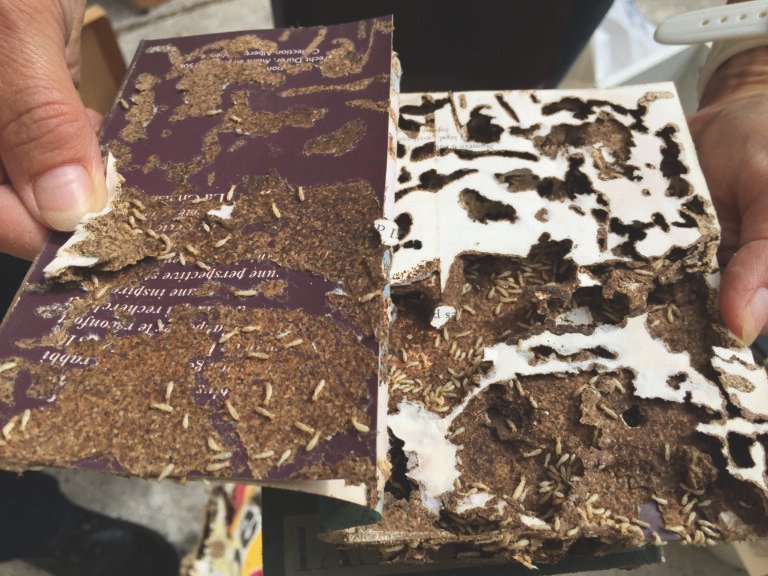
Understanding what termites eat helps explain the damage they can cause in a home. Contrary to popular belief, these insects do not feed exclusively on wood. They primarily seek out cellulose, a substance naturally present in many plant-based materials.
This very specific diet shapes their lifestyle, their colonial organization, and even the strategies used to eliminate them. Let’s explore why cellulose is essential to their survival and how this characteristic influences their behavior.
Would you like to start by learning how termites work, how they’re organized, and the risks they pose to a home? Check out our comprehensive guide to termites.
Key Information You Need to Know
- Termites feed mainly on cellulose.
- Wood isn’t the only material involved.
- The workers feed the entire colony through trophallaxis.
- This method of feeding is used in certain termite control treatments.
Do termites feed only on wood?
No. Even though wood is their main food source in homes, termites are actually after cellulose, a natural component found in many plants.
Are you wondering why termites primarily attack the wooden parts of a home? Check out our feature on wood-destroying termites and the risks they pose to your home.
Termites !Time to eat!
Termites can therefore consume various materials that contain cellulose, including:
- the woods
- the cardboard box
- paper
- books and archives
- certain types of wallpaper or wood-based panels
In their natural environment, termites help recycle dead wood and other plant matter. However, when they infest a building, this same ability can cause significant damage to cellulose-containing materials.
Damage caused by termites often goes unnoticed for a long time. Find out why in our feature on termite damage.
Why do termites seek out cellulose?
Cellulose is their main food source. Found in plant cell walls, it is a component of wood, cardboard, and paper, among other things.
However, termites cannot break down this material on their own. In subterranean termites of the genus Reticulitermes, cellulose digestion relies on a system that combines enzymes produced by the termite itself with the activity of symbiotic microorganisms present in its digestive tract. This cooperation enables them to efficiently utilize cellulosic materials.
This digestive process explains why their diet is closely tied to cellulose-rich materials.
To better understand the colony’s structure and the role of each caste, check out our feature on the lifestyle of termites.
Can termites damage materials that they do not consume?
Yes, and that’s an important distinction.
To reach a source of cellulose, termites can also travel through cracks, joints, interfaces between materials, or certain elements that they do not consume directly. In this way, they can cause damage along their path even if the material in question is not necessarily a food source.
However, the situation depends on the material’s composition: some products or cladding may themselves contain cellulosic fibers that can be consumed.
Why do worker termites play such a vital role?
In a colony, worker ants play a central role in feeding the colony. They search for sources of cellulose, maintain the tunnels, care for the young, and help feed the other members of the colony. Their activity is thus directly linked to the damage caused when the colony breaks down the cellulosic materials in a building.
The damage observed in homes is therefore primarily due to the ongoing activity of worker termites.
Workers are constantly looking for new sources of cellulose
Worker termites explore their environment to locate new food sources. As soon as they discover a material rich in cellulose, they can gradually exploit it while continuing to share food with other members of the colony.
This constant search explains why an infestation can spread unnoticed from one piece of wood to another—sometimes over several years—before the first signs become visible.
Trophallaxis: A Behavior Essential to the Survival of Termites
One of the most remarkable behaviors of termites is trophallaxis.
This term refers to the exchange of food among colony members. After consuming cellulose, worker termites redistribute part of this food to other colony members: soldiers, larvae, nymphs, and reproductive termites.
Among subterranean termites, certain forms of trophallaxis also contribute to the circulation of symbiotic microorganisms involved in their digestive processes. Without this ongoing cooperation, termites would be unable to maintain their social organization.
This food-sharing behavior is one of the termites’ greatest strengths… but it is also a behavior that is harnessed in the Sentri Tech process, developed by Corteva Agriscience™.
Materials that attract termites
| Material | Why are termites interested in it? |
| Wood | It is naturally rich in cellulose, their main source of food. |
| Cardboard | Composed of easily digestible cellulose fibers. |
| Paper | Made from plant-based cellulose. |
| Books and Archives | Their paper can serve as a food source for termites. |
| Wallpaper | Some contain cellulosic fibers that can be consumed. |
| Non-cellulosic materials located along their path (gypsum boards, ductwork, or insulation) | Although they do not consume them as food, termites can use cracks, joints, or interfaces to reach a source of cellulose located beyond them. |
Why is it important to understand how termites feed?
Understanding what termites eat not only explains the damage they can cause to a home, but also helps us understand how they move, organize their colony, and constantly search for new sources of cellulose.
This knowledge also helps us understand how certain bait-based pest control systems work, as they take advantage of the colony’s feeding and social behaviors.
Why is trophallaxis at the heart of the Sentri Tech process?
Trophallaxis is a mechanism essential to the survival of a termite colony. Workers do not simply feed themselves; they then redistribute part of that food to other members of the colony, particularly soldiers, larvae, and reproductive termites.
This ongoing cooperation allows the entire colony to thrive, even when some individuals are unable to feed themselves directly.
It is precisely this natural behavior that the Sentri Tech process takes advantage of.
The Sentri Tech method relies on a bait containing a patented active ingredient developed by Corteva Agriscience™, which worker termites consume naturally. This active ingredient works by preventing them from molting.
By continuing the food exchanges essential to the colony, the workers gradually spread this active substance to their fellow termites through trophallaxis. The process thus harnesses a biological behavior unique to termites to exert an effect on the colony as a whole.
Would you like to understand how this strategy is implemented in the field? Learn how to eliminate termites using the Sentri-Tech method.
In practice
Understanding what termites eat helps explain their behavior, how they spread through buildings, and the damage they can cause. Their constant search for cellulose, their colonial organization, and trophallaxis are the three key factors that explain both their effectiveness… and the strategies currently used to combat them.
A better understanding of their feeding habits also makes it possible to take more appropriate action when an infestation is suspected or confirmed.
Frequently asked questions
Do termites eat only wood?
No. They are primarily interested in cellulose, which is found in wood but also in cardboard, paper, certain types of wallpaper, and other plant-based materials.
Do termites eat drywall?
Mineral plaster itself is not a source of cellulose. However, some of the materials used with it, such as the paper facings on gypsum boards, may contain cellulose fibers. Termites can also use cracks or joints to reach a food source beyond them.
Can termites damage books?
Yes. Books are made of paper, which is itself made from cellulose. Therefore, they can be eaten if termites have access to them.
Why do termites share their food?
Through a process called trophallaxis, worker bees redistribute food to other members of the colony, ensuring its survival and growth.
Why is trophallaxis important in termite control?
This is because certain processes take advantage of this natural behavior to gradually distribute an active substance throughout the colony. Food exchanges among termites thus play a crucial role in the effectiveness of these processes.
Key Points About Termite Feeding Habits
- Wood is their main source of food inside buildings.
- Cardboard, paper, and books also contain cellulose.
- Termites can pass through or bypass certain non-cellulosic materials to reach a food source.
- Worker termites provide food for the entire colony through trophallaxis.
- Understanding this behavior helps explain certain intervention strategies implemented by professionals.