
Termites are social, wood-eating insects that live in organized colonies and feed primarily on cellulose. In a home, their activity can gradually weaken certain wooden structural elements while remaining undetected for a long time. This page explains what a termite is, how a colony functions, and why these insects can pose a risk to buildings.
For an overview of the topic, you can also check out our comprehensive guide to termites, which brings together the key information on how they behave, the risks they pose to a home, signs of infestation, and possible solutions.
Key points to remember
- Termites are social insects that live in colonies organized into several castes.
- They feed mainly on cellulose, which is found in wood but also in other plant-based materials.
- Their activity can remain difficult to detect for a long time, because many termites move through the soil or inside building materials.
- An infestation can gradually weaken a home’s structure before the first visible signs appear.
- Early detection generally makes it possible to limit the damage and implement appropriate solutions.
Termites at a Glance
| Question | Answer |
| What are termites? | Social insects that live in organized colonies. |
| What do they eat? | Primarily the cellulose found in wood and other plant materials. |
| Why are they hard to detect? | Because they are most often found inside wood or in the soil. |
| What are the main risks? | The gradual deterioration of a building’s wooden components. |
| What should you do if you’re not sure? | Have the situation assessed before taking any action. |
What Is a Termite? A Simple and Precise Definition
Termites are social insects belonging to the order Blattodea. Highly organized into complex colonies, they feed primarily on cellulose, a substance found in wood, plant fibers, and certain organic materials.
The colony is organized into several castes, including workers, soldiers, and breeders. Each caste performs complementary functions that are essential to the colony’s food supply, defense, and development.
Why do termites live in colonies?
The survival of termites depends on a highly efficient collective organization. Each individual performs a specific function that enables the colony to forage for food, protect itself, and grow continuously. This cooperation explains their ability to gradually colonize a building while remaining undetected for long periods of time.
To learn more about the structure of the colony and the role of each caste, see our feature on thelifestyle of termites.
How does a termite colony work?
Social Organization of the Colony
Each termite plays a role in the colony:
- miners: responsible for supplying and maintaining the tunnels
- soldiers: provide defense
- Breeding individuals: ensure the colony’s survival
This division of labor enables the colony to ensure its food supply, defense, and reproduction.
Life Cycle of Termites
A termite’s development begins with an egg and proceeds through several juvenile stages. The exact sequence of these stages and the differentiation of individuals vary depending on the species and their future role in the colony.
To learn more about reproduction and colony organization, see our feature on the lifestyle of termites.
Why do termites attack houses?
Termites seek out cellulose, which is their primary food source. In a home, they can find it in wood as well as in various plant-based materials.
To learn more about their diet, check out our feature What Do Termites Eat?
If you’re wondering whether your home might be affected, see our guide Termites in Your Home: How Do You Know If Your Home Is Affected?
Homes are often a readily available source of cellulose:
- beams and trusses
- floors and stairs
- woodwork and wood elements integrated into the building structure
- paper, cardboard, or other materials containing cellulose
Termites can enter through:
- the ground,
- cracks,
- crawl spaces,
- certain points where the wood meets the masonry.
The main entry points for termites
| Origin | Why is this a sensitive issue? |
| Floor | Subterranean termites naturally live in the soil. |
| Cracks in the Foundation | They can help them advance into the construction industry. |
| Wood in contact with the ground | It provides direct access to their food source. |
| Crawl Spaces | They provide conditions that are conducive to their movement. |
Signs of a termite infestation: what to look for
Certain signs may be cause for concern: wood that sounds hollow, earthy-smelling shavings, unusual deformities, or weakened wooden components. However, no single sign is sufficient on its own to confirm an infestation.
To find out exactly what to look for, check out our guide on the signs of a termite infestation.
Risks to a Home: What You Need to Know
Termites don’t just eat wood. Their prolonged presence can lead to:
- gradual deterioration of wooden components
- deterioration of roof structures, floors, or woodwork
- internal damage that may remain difficult to detect for a long time
- a loss of resistance in certain elements when an attack is advanced
In particular, the absence of visible signs does not mean there is no risk: it is the internal and underground nature of their tunnels that often causes the damage to go unnoticed until later.
If your home is located in an affected municipality, it is also helpful to understand how termite-risk zones are defined in France.
Is the damage still visible?
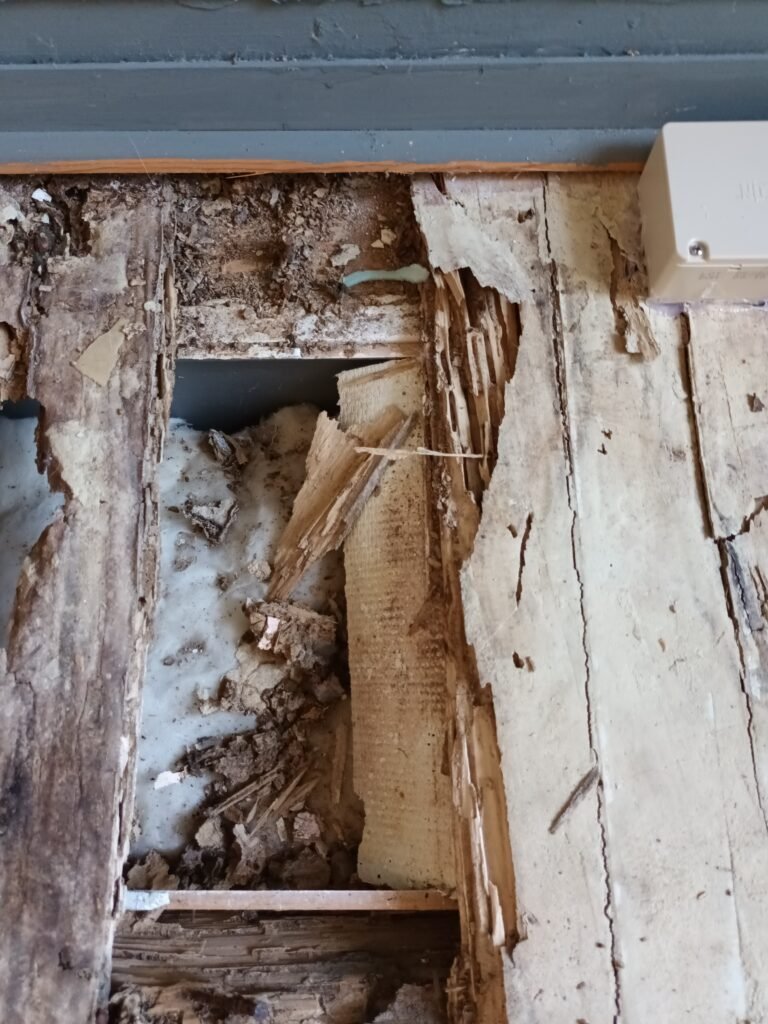
No. Termites eat away at wood from the inside, often leaving a thin outer layer intact. This characteristic explains why some structural or woodworking components may appear to be in good condition even though they have already lost a significant portion of their mechanical strength.
This mechanism is explained in detail in our feature on invisible damage caused by termites.
Are termites subject to regulations in France?
Yes. The presence of termites is governed by a regulatory framework that requires, among other things, the reporting of their presence, the zoning of certain areas, and, in certain sales situations, the conduct of a termite inspection.
To understand all of these rules, see our guide on termite regulations in France. To learn more about the specific role and process of a real estate inspection, see our page on termite inspection.
Can an infestation be prevented? Possible steps to take
A preventive approach may be considered depending on the building’s condition, its surroundings, and the local context. It relies in particular on monitoring and systems tailored to the building.
To learn more about the solutions offered by Sentri Tech, visit our page on preventive termite treatment.
What should you do if a termite infestation is confirmed?
When a termite infestation is confirmed, the condition of the building must be assessed to determine the appropriate remedial treatment and follow-up measures. The goal is not only to address visible damage, but also to target the termite activity causing the problem.
To learn about the steps involved and possible solutions, see our guide ” How to Get Rid of Termites?”
Key Takeaways
Termites are among the main insects capable of causing long-term damage to a building. Their lifestyle, their stealth, and their colonial organization explain why they can remain in a building for several years before being detected.
A better understanding of how they operate allows for faster identification of high-risk situations, a clearer understanding of regulatory requirements, and the ability to take action before damage becomes significant. If in doubt, the source of any observed signs should be verified before selecting a potential solution. The regulatory termite inspection, on the other hand, adheres to a specific framework, particularly in connection with certain real estate transactions.
To learn more about this topic, you can continue reading:
- Termites: The Complete Guide to Understanding, Detecting, and Taking Effective Action
- Termite Inspection: Definition, Legal Requirements, and Differences from a Pest Inspection Report
- Termite risk areas: how are they defined in France?
Frequently asked questions
Are termites dangerous to humans?
The main risk associated with termites concerns buildings and materials containing cellulose. In France, they are not considered vector insects that pose a health risk comparable to that of certain human parasites.
Can a newly built house be targeted?
Yes. Termites are looking for a food source, not an old building. So even a recently built structure can be affected if conditions are favorable.
Do termites go away on their own?
You should not expect termite activity to disappear on its own once it has been identified in a building. As long as conditions remain favorable and the colony remains active, the damage may continue.
Are all insects that attack wood termites?
No. Capricorn beetles, wood borers, and lyctus beetles are also wood-boring insects, but their biology, the damage they cause, and the treatments used to control them are different.