
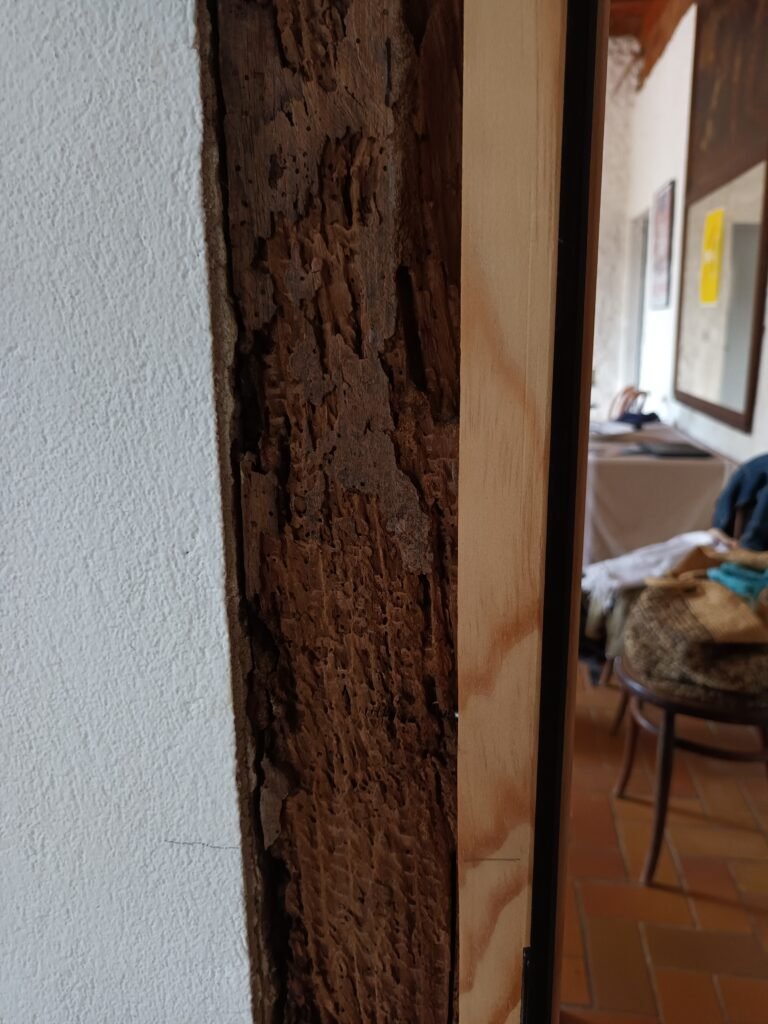
The presence of termites in your home is a legitimate concern for many homeowners. These insects can go unnoticed for a long time and weaken a home without any obvious signs on the surface. This page will help you understand whether your home might be at risk, what signs to look for, and how to respond thoughtfully, without rushing or panicking.
Key points to remember
• A house may have a termite infestation even if there are no visible signs on the surface.
• The presence of termites depends, in particular, on the building’s location, its surroundings, and conditions that are conducive to their growth.
• Certain signs (hollow wood, tunnels, warping, or cracks) should prompt you to have your home inspected.
• Termites aren’t the only insects that can damage wood: when the signs are unclear, a proper inspection can help determine the cause.
• If in doubt, it’s best to have the situation checked rather than wait for more serious damage to occur.
How can you tell if you have termites in your house?
Termites are rarely visible to the naked eye. However, their presence can be suspected based on several signs that can be observed in a home:
- wood that has become brittle, sounds hollow, or crumbles easily
- earthy streaks or trails on a wall, floor, or near a wooden structure
- a baseboard, hardwood floor, or other wooden element that warps or gives way under light pressure
- doors or windows that start to stick in an unusual way
- the presence of wings left behind after swarming
None of these signs, on its own, can confirm with certainty the presence of termites. Conversely, the absence of visible signs is not enough to rule out an infestation, since termites can move through the soil or inside the wood.
If you notice several signs, avoid dismantling or treating the suspicious areas yourself before they are inspected. To learn how to interpret each of these signs, see our guide on signs that may indicate the presence of termites.
Is my house at risk? The main factors
| Factor | Impact on Risk |
| Geographic Location | Some municipalities are more vulnerable than others. |
| Humidity | Humid environments are more conducive to termites. |
| Wood in contact with the ground | It makes it easier for termites to get into the building. |
| Presence of a colony nearby | It increases the risk of the fire spreading to the home. |
| Age of the house | An older house is not necessarily more vulnerable than a newer one. |
Termites in a house: What exactly are we talking about?
When it comes to termites in a house, they are most often subterranean termites. These insects live in the ground and enter buildings through hidden tunnels to reach materials that contain cellulose.
To better understand how they work, it is helpful to learn about the lifestyle of termites.
Why Might Your Home Be at Risk of Termite Infestation?
The presence of wood and sensitive materials
Termites attack materials containing cellulose, particularly wood. A house has many such components: roof frames, floors, stairs, door and window frames, and partitions.
The connection between termites and food is explained in the article on this topic, which you can read here.
Favorable conditions in the home
Certain situations can make your home more vulnerable to termites:
- wood in direct contact with the ground,
- damp or poorly ventilated areas,
- crawl spaces, cellars, or basements,
- cracks or points of contact between the ground and the structure.
These layouts apply to both older homes and newer buildings.
Are all homes susceptible to termites?
The level of risk varies greatly from one home to another.
It depends, in particular, on:
- geographic location,
- of the immediate surroundings,
- the type of frame,
- humidity conditions.
To see where your home fits in on a national scale, it’s helpful to check out the termite map of France, which you can find here. This map provides a basic level of information and should be interpreted with caution.
Could a newly built house be affected?
Yes. Contrary to popular belief, termites don’t just attack older buildings. A newer home can also be affected if it’s located in a high-risk area and if termites find a way to access materials containing cellulose.
To find out which areas are officially affected, see: Termite-risk areas: How are they defined in France?
Why can damage remain hidden for a long time?
Internal decay of wood
Termites eat away at wood from the inside, sometimes leaving a thin layer on the surface.
As a result, your home may appear to be in good condition even though some structural elements have already been weakened.
This phenomenon is explained in the article on the invisible damage caused by termites, which you can read here.
House Termites or Other Wood-Destroying Insects: How Can You Tell the Difference?
Termites are often confused with other wood-boring insects, such as woodworms or longhorn beetles.
The key difference lies in their colonial organization, their continuous spread, and the potential extent of the damage they cause.
Doubts can only be resolved through an appropriate analysis conducted by a qualified professional.
How can you confirm that they are indeed termites?
Even when several signs seem indicative of a problem, their cause must be verified before drawing a conclusion. Other wood-boring insects or certain types of building damage can produce similar symptoms. A proper inspection can identify the cause of the problems and determine the appropriate course of action.
In the context of a real estate sale, the termite inspection must comply with specific regulations, which we detail in our dedicated guide.
What should you do if you suspect you have termites in your home?
If in doubt, avoid covering, dismantling, or treating the suspicious areas yourself before they are examined. Start by noting the observed clues and have the situation checked when they are sufficiently indicative.
If you are in the process of selling a property, the conditions under which a termite inspection is required are detailed in our dedicated guide. If the presence of termites is confirmed outside of this context, learn about the various termite treatment options—both curative and preventive—as well as the steps to follow to eliminate termites.
Termites in the Home: Take a Methodical and Thoughtful Approach
The presence of termites in your home is neither inevitable nor always immediately apparent. Each situation depends on many factors: the environment, the structure of the building, humidity, and location.
Understanding these factors allows you to take a methodical approach without panicking.
When necessary, consulting with a qualified professional can provide you with appropriate advice. If you’d like to have your situation evaluated, you can find a Authorized Sentri Tech Installer near you.
Key Takeaways
Not all homes are affected by termites, but no home can be considered completely safe from them. The home’s location, its surroundings, and certain characteristics of the building all influence the level of risk.
By recognizing the main warning signs and the conditions that promote termite infestations, it becomes possible to take action at the right time. If in doubt, having a professional assess the situation will help determine whether the signs observed require treatment. When selling a property located in an affected area, this inspection is part of the required termite inspection.
Frequently asked questions
How do I know if I have termites in my home?
Since termites are rarely visible directly, their presence is usually suspected based on certain signs: wood that sounds hollow or becomes brittle, mud tubes, unusual warping of wooden components, or wings left behind after a swarm. However, no single sign can confirm an infestation with certainty. If in doubt, it’s best to have the situation inspected before taking any action.
Can I have termites without ever seeing them?
Yes. Termites generally live inside wood or in the ground. As a result, an infestation can go unnoticed for several years.
Can a new house be affected?
Yes. It is not the age of the building that determines the risk, but rather the conditions that allow termites to access cellulose-containing materials.
Are all types of wood affected?
Termites primarily seek out materials that contain cellulose. Certain types of wood or treatments can limit their growth, though they do not completely eliminate the risk.
What should I do if I think I have termites in my home?
Start by having the observed signs inspected without taking any action yourself in the suspect areas. The regulatory termite inspection, on the other hand, follows a specific framework, particularly when selling a home located in an area designated by a prefectural order.