
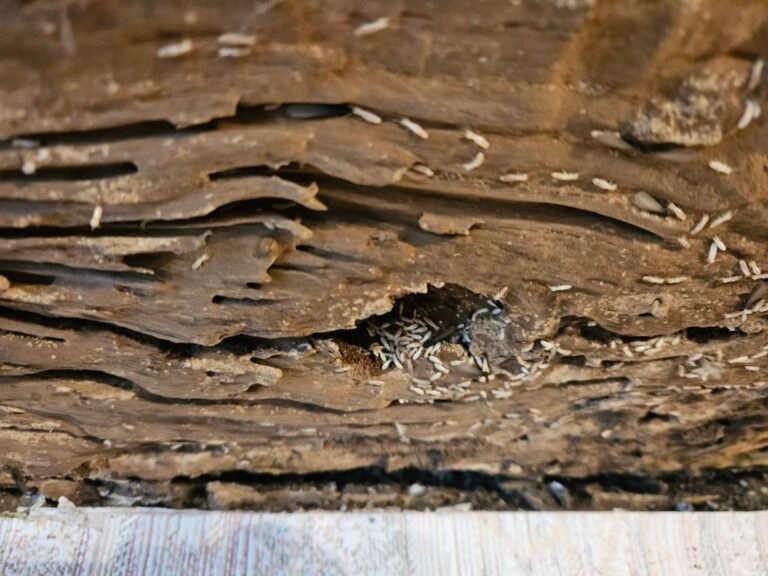
Wood-destroying termites are among the insects most feared by homeowners. Invisible, silent, and capable of feeding for months without leaving any visible traces, they directly attack the wooden structures of homes.
Understanding why wood is their target, which parts of the house are affected, and what risks this poses to a home allows you to make informed decisions without rushing or causing unnecessary anxiety.
Key Takeaways
• Termites attack wood because it contains cellulose, their main source of food.
• In France, the most common species live in the soil before making their way into buildings through hidden tunnels.
• The damage often remains hidden for a long time, because termites eat away at the wood from the inside.
• Any wooden parts of a house may be affected if they are accessible to termites.
• When in doubt, an examination of the observed signs can help identify the cause before considering any possible intervention.
Understanding Termites: A Few Key Points
| Question | Answer |
| Why do termites attack wood? | Because it contains cellulose, their main food source. |
| Does this apply to all types of wood? | Many types of wood are susceptible to decay, but their susceptibility varies depending on their natural durability, any treatment they may have undergone, and the conditions under which they are used. |
| Do termites live in wood? | It depends on the species. Subterranean termites live mainly in the soil and burrow into wood to feed; drywood termites live directly in the wood they colonize. |
| Is the damage visible right away? | No. They often remain undetected for several months, or even several years. |
| What should you do if you’re not sure? | Have the observed signs examined before taking any action. |
Wood-destroying termites: What exactly are we talking about?
The term “wood termites” is commonly used to refer to termites that damage the wooden components of a building. However, it does not refer to a specific scientific category.
In metropolitan France, the main infestations of buildings are caused by subterranean termites of the genus Reticulitermes, which live in the soil and invade wooden structures to feed. A species of drywood termite, Kalotermes flavicollis, is also present, mainly in the Mediterranean region, but its economic impact on buildings is much more limited.
To understand how a colony is organized and functions, check out our feature on the lifestyle of termites.
Why do termites attack wood?
Cellulose: Their Food Source
Termites attack wood because it contains cellulose, their primary food source. Therefore, it is not wood as a material that accounts for their activity, but rather its composition.
To learn more about their diet and the role of cellulose, check out our feature article What Do Termites Eat?
Why aren’t termites interested in all materials?
Termites primarily seek out materials that contain cellulose. Concrete, metal, and stone are therefore not part of their diet. However, they can use cracks, joints, or other pathways to reach a cellulose-containing material.
Discreet access from the ground
Subterranean termites of the genus Reticulitermes live primarily in the soil and then invade the wooden components of a building through tunnels that protect them from light and drying out.
This underground spread explains why an infestation can remain undetected for a long time, even when the wood appears visually intact.
Favorable conditions in the home
Certain conditions make it easier for termites to attack wood:
- wood in direct contact with the ground,
- humid or poorly ventilated areas,
- crawl spaces, cellars, and basements,
- wooden elements integrated into the masonry.
These conditions can make it easier for termites to gain access or create conditions conducive to their spread. The level of exposure, however, depends on many factors, including geographic location, building design, and any protective measures that may have been implemented.
Which types of wood are susceptible to termites?
The various wooden components of a building may be susceptible to termite damage if they are accessible to termites. However, their vulnerability varies; it depends, in particular, on the species of wood, its natural durability, whether it has been treated with a preservative, and the conditions under which it was installed.
Termites can infest:
- on roof frames,
- to the beams and joists,
- on the floors,
- on door and window frames,
- by the stairs,
- partitions containing wooden components.
For subterranean termites, access to wood from the ground or through the building’s structural elements is also a key factor.
What are the risks to a house?
Often invisible damage
Termites hollow out wood from the inside, sometimes leaving a thin layer on the surface.
The damage does not become visible until later, when the structure is already weakened.
These mechanisms are described in detail in the article on the invisible damage caused by termites, which you can read here.
Progressive damage to the building’s structure
Over time, an infestation can lead to:
- sagging floors,
- the deterioration of roof structures,
- warping of woodwork,
- a loss of strength in certain load-bearing components.
These issues are often discovered during construction work or a real estate transaction, when the condition of the building is examined more closely.
The Main Consequences of an Infestation
| Affected item | Possible consequence |
| Roof Framing | Gradual deterioration |
| Floor | Loss of strength, sagging |
| Staircase | Deformation or Instability |
| Woodwork | Difficulty opening or closing |
| Wood-frame construction | Decrease in mechanical strength |
Wood-destroying termites: What are the warning signs?
An infestation may eventually reveal certain signs: wood that sounds hollow, earthy frass, warping, or weakened wooden components. However, these signs may have various possible causes, and on their own, they do not necessarily indicate the presence of termites.
To find out exactly what to look for, check out our guide on signs of termite infestation.
Wood-destroying termites or other wood-boring insects: Beware of confusion
Termites aren’t the only insects capable of damaging wood. Longhorn beetles, wood borers, and lyctus beetles have different life cycles and can leave distinct signs. The nature of the tunnels, any debris observed, and the appearance of the insects or larvae can all help in identifying the species.
When there is any doubt, a specialized inspection can determine the cause of the damage before deciding on any necessary repairs.
What should you do if you suspect you have termites in your wood?
If you notice any suspicious signs, it is best to avoid covering up or damaging the affected areas before they are examined. A professional can analyze the signs and assess the situation to determine whether action is needed.
Termite inspections, on the other hand, are subject to a specific regulatory framework: when a building located in an area designated by prefectural decree is sold, a report on the presence of termites must be provided to the buyer.
• For specific details on these rules, visit our page on mandatory termite inspection.
• If a termite infestation is confirmed, find out how to get rid of termites.
Understanding Wood-Destroying Termites to Take Better Action
Wood-destroying termites are neither immediately visible nor universally present. Their impact depends on many factors: the environment, the type of structure, humidity, and accessibility.
A clear understanding of these mechanisms allows us to act judiciously, without unnecessary alarm.
When the situation calls for professional advice, you can find a Sentri Tech Authorized Applicator near you to have the signs you’ve observed examined and to discuss any necessary treatment.
What to Keep in Mind
Termites attack wood because it is their main source of food. Their subterranean lifestyle and their ability to move about undetected explain why the damage is often discovered too late.
Understanding these mechanisms makes it easier to identify situations that require verification. If suspicious signs are present, their origin must be investigated before deciding whether to take action.
To learn more about this topic, you can also check out our comprehensive guide to termites, which brings together key information on how they operate, the risks they pose to homes, and solutions for preventing or treating an infestation.
Frequently asked questions
Do termites only attack old wood?
No. Termites are attracted to cellulose, whether it’s found in old or newer wood.
Is treated wood completely protected?
Not necessarily. Preservative treatment can make wood resistant to certain biological agents, depending on the product, its intended use, and the application conditions. The durability of wood also depends on its species and its specific characteristics.
Can termites get through a wall?
They do not feed on concrete or stone. Subterranean termites, however, can use cracks, joints, or other pathways to reach a material containing cellulose.
Can a beam that appears to be intact be attacked?
Yes. Termites often hollow out wood from the inside while leaving a thin outer layer intact.