
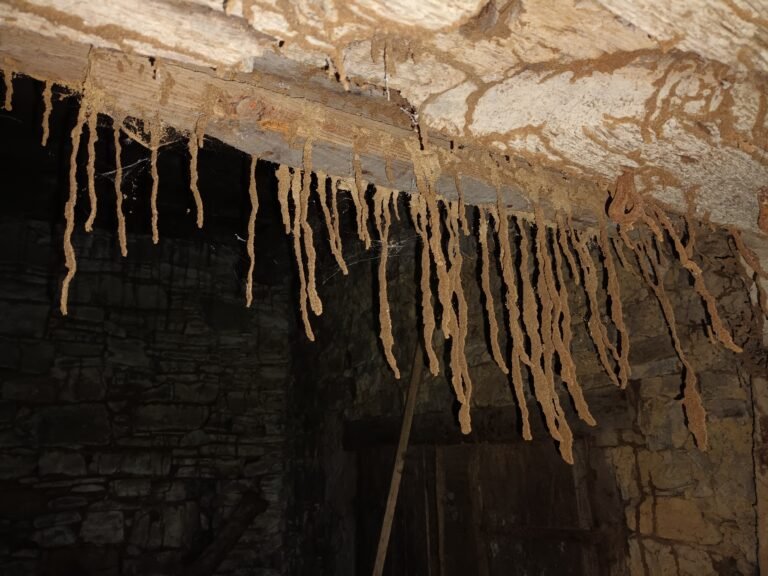
Termites are social, wood-eating insects capable of damaging wood and other cellulose-containing materials. Their activity can remain difficult to detect for a long time when it occurs away from light or inside building structures.
This guide brings together the essential information needed to understand how they work, recognize the main signs, understand the situation in your area, and distinguish between regulatory assessment, prevention, and treatment. Each section also provides access to Sentri Tech resources that focus more specifically on these various topics.
Key points to remember
- Termites are social insects that live in colonies and feed primarily on materials containing cellulose.
- They can move through the wood or in the dark, which sometimes makes them difficult to spot.
- Earth-colored fronds, brittle wood, deformities, or shed wings may be noticeable, but they are not sufficient on their own to confirm an infestation.
- Termites are found in many regions of France, but their presence and the regulatory zoning vary by department and municipality.
- When termites are found in a building, the discovery must be reported to city hall. Other requirements may apply depending on the location and condition of the property.
Termites at a Glance
| Question | Answer |
| What do termites eat? | Primarily materials containing cellulose, such as wood, paper, or cardboard. |
| Where do they live? | It depends on the species. The Subterranean termites live primarily in the soil and migrate toward buildings, while some species can live directly in wood. |
| Are they visible? | Rarely. They are often active in the soil, inside wood, or in passages sheltered from light. |
| Are termites found throughout France? | No. They are found in many French regions, but their distribution is not uniform, and regulatory zoning varies by department and municipality. |
| What is the main risk? | The gradual deterioration of certain cellulose-containing materials, particularly wooden structural elements in buildings. |
| What should you do if you’re not sure? | Document any signs you observe and have the situation assessed before taking any action. The Regulatory termite inspection must follow a specific framework, particularly in connection with certain real estate sales. |
Termites: A Silent Threat That Can Weaken Your Home
Subterranean termites live in the dark, particularly in the soil, in wood, or within protected tunnels. As a result, their activity can progress without immediately producing obvious signs on the surface of materials.
This discreet nature explains why a termite infestation is sometimes discovered during construction work, a building inspection, or when certain signs become visible. The absence of obvious signs, therefore, does not in itself rule out the possibility of termite activity.
What is a termite, and how does a colony function?
Termites are social insects that live in colonies. Within the colony, individuals fulfill different roles that contribute to its collective functioning:
- In particular, the workers are responsible for finding and sharing food
- The soldiers are helping to defend the colony.
- Breeding animals ensure its reproduction and development
This collective organization allows termites to make use of available resources and ensure the colony’s functioning.
- To learn more about the key characteristics of this insect, see our feature Termites: Definition, How They Work, and Risks to Your Home.
- To learn more about the colony’s organization, the role of castes, and reproduction, check out the lifestyle of termites.
Why Termites Pose a Real Threat to a Home
Wood is a source of cellulose that termites can access. In a building, various components may therefore be affected, including:
- the roof frame
- the beams
- the floors
- woodwork and other wooden components
Termite activity can develop within the material before the damage becomes readily apparent on the surface. The extent and consequences, however, depend on the building’s condition, the affected components, and the level of termite activity present.
- To understand why wood is particularly vulnerable and which parts may be affected, see our feature on termite-damaged wood.
- To understand how certain types of damage can progress without being immediately visible, be sure to check out our feature on invisible damage caused by termites.
How can you tell if you have termites?
Termites are difficult to spot directly, but certain signs may catch your attention. However, none of these should be interpreted on its own as definitive proof of an infestation.
The most common signs
- wood that is brittle or sounds hollow
- streaks of dirt on a wall, floor, or part of the building
- wings left behind after swarming
- unusual warping of certain wooden components or finishes
- wood that crumbles under light pressure
To learn how to recognize and interpret these various signs, see our feature on signs of termite infestation.
The Most Revealing Indicators
| What You See | May refer to |
| Wood that is brittle or sounds hollow | An internal issue that needs to be examined |
| Ground Strings | A telltale sign of subterranean termite activity |
| Wings near an opening | A swarm may have occurred nearby |
| Deformation of a component or coating | An anomaly to investigate, not specific to termites |
| Crumbling wood | Deterioration of the material, the cause of which must be determined |
None of these signs alone is sufficient to confirm an infestation. However, their presence warrants a more detailed assessment of the situation before taking any action.
If your first question is whether your home might be affected, see Termites in Your Home: How Do You Know If Your Home Is Affected?
Please note: Not all wood-boring insects are termites.
Some damage observed in wood may have a different cause. Longhorn beetles, wood borers, and lyctus beetles are also wood-boring insects, but their biology, the signs they produce, and the methods for dealing with them differ from those of termites.
It is therefore necessary to correctly identify the cause of damage before drawing any conclusions or considering any corrective action.
What should you do if you suspect you have termites?
When suspicious signs are present, the goal is not to treat the condition immediately, but first to understand what is being observed.
The process can involve several steps:
- identify and record the observed clues
- Avoid immediately removing the affected components
- have the situation investigated to determine the source of the clues
- If termite activity is confirmed, choose the appropriate course of action
- then carry out the follow-up required by the selected method
For more detailed information on the steps to take when an infestation is confirmed, see our guide How to Get Rid of Termites?
When termites are found in a building, this must also be reported to city hall. This report must be filed within one month of the discovery.
Where are termites found in France?
Termites are found in many regions of France, but their distribution is not uniform. Termites are found in many regions of France, but their distribution is not uniform. The biological presence of termites in a region and its regulatory classification are two related pieces of information, but they should not be confused.
To understand their presence in mainland France and in the overseas departments and regions, see our overview on termites in France.
- To understand how these areas are defined, see our guide on termite-risk areas
- You can also view the map of termite infestations in France.
However, a map must be interpreted based on its source, date, and the information it depicts. Read our explanations in Map of Termites in France: How to Interpret It Correctly?
Why are some municipalities classified as high-risk?
When termite infestations are identified in one or more municipalities, a prefectural order delineates the areas that are infested or likely to become infested in the near future. This zoning then serves as a reference for various regulatory provisions. (Source: Légifrance, Building and Housing Code, Article L131-3)
- To gain a clear understanding of the role and scope of this regulation, please see our feature onthe prefectural decree regarding termites.
- For a broader overview of the regulations applicable in France, please also see our summary on the regulations regarding termites.
- You can now access information available for your area in our “Termites by Region and Department”section.
Termite Inspection: When Is It Necessary?
The termite inspection—whose official name is the “report on the presence of termites”—follows a specific real estate framework. It should not be confused with the assessment conducted by a professional prior to any potential treatment.
When selling a home located in an area designated by prefectural order as infested with termites or at risk of infestation in the near future, the seller must provide this inspection report to the prospective buyer. The report is valid for a maximum of six months. The inspection must be conducted by an inspector who meets the regulatory certification criteria. (Source: Service Public, “Termite and Other Wood-Destroying Insect Inspection”)
- For specific details on the situations covered, see also “Mandatory Termite Inspection.”
Termite Treatment: What Really Makes the Difference
Prevention and curative treatment address two different situations. A preventive approach applies to a building in which no termite activity has been identified, whereas curative treatment is used when termite activity has been confirmed.
The choice therefore depends on the actual condition of the building and the desired outcome, not solely on the presence of termites in the department.
When should you consider preventive treatment against termites?
A preventive approach aims to protect or monitor a building when no termite activity has been identified. Its effectiveness depends, in particular, on the property’s location, layout, and surroundings.
Certain measures can also help limit factors that contribute to decay around the structure: pay close attention to where wood comes into contact with the ground, to persistent moisture problems, and to the condition of the wooden components.
- To learn more about Sentri Tech’s approach, visit our page on preventive termite treatment.
When should you implement a curative treatment against termites?
Curative treatment is performed when termite activity is confirmed and action must be taken. The method chosen must be appropriate for the building’s condition and the identified termite activity.
- To understand the steps that follow the confirmation of an infestation, see our guide How to Get Rid of Termites?
- To learn more about how the bait-based control system works, see the Sentri-Tech method.
- Finally, to compare solutions based on your situation, their duration, and the factors that determine their price, check out our guide Termite Treatment: Solutions, Prices, and Duration.
Why hire a professional?
Termite control begins with an assessment of the building’s condition, followed by the selection and implementation of an appropriate method. Follow-up is then part of the treatment process, depending on the method used.
To understand the role of these professionals and the various steps involved in their work, find out why you should hire a company that specializes in termite treatment.
- To get started, you can also look for a authorized Sentri Tech installer near you.
Termites: Comprehensive and Useful Answers
How can I know for sure if my house has a termite infestation?
Certain signs may indicate a termite infestation: mud tubes, weakened wood, wings left behind after swarming, or unusual deformities. However, these signs alone are not always sufficient to confirm an infestation.
For more information on this topic, see Termites in Your Home: How Can You Tell If Your Home Is Affected?
Can termite activity remain difficult to detect for a long time?
Yes. Termite activity can occur underground, inside wood, or in protected tunnels without being immediately visible on the surface. However, the duration and progression of the infestation depend on the specific situation: the absence of visible signs alone is not enough to determine how long the termites have been present.
To understand why some types of damage are hard to detect, check out our feature on invisible damage caused by termites.
Do termites only attack older homes?
No. The age of the building alone is not enough to determine whether it is at risk. A recently constructed building may also be at risk, depending on its location, design, surroundings, and the availability of materials containing cellulose.
What are the risks if I don’t seek treatment right away?
An untreated infestation can lead to:
- structural weakening
- significant damage
- depreciation of the property
In advanced cases, extensive and costly repairs become necessary.
In what cases is a termite inspection required?
A termite inspection is not required everywhere in France. When a property is sold, a termite inspection report must be provided if the property is located in an area designated by prefectural order as infested with termites or at risk of infestation in the near future. The report is valid for up to six months.
Find details on the situations covered in our report Mandatory Termite Inspection.
What is the difference between preventive and curative treatment?
Preventive treatment is performed when no termite activity has been identified, in order to protect or monitor the building. Curative treatment addresses a different situation: termite activity has been confirmed, and the goal is to treat the affected colony.
These two approaches are therefore not interchangeable and are intended for different situations.
Is termite treatment permanent?
A curative treatment aims to eliminate the colony responsible for the identified activity. This does not mean that a building will never be exposed to new termite activity in the future. Depending on the situation, further treatment may be necessary if termites reappear.
How can I tell if termites are a problem in my town?
The presence of termites and regulatory zoning vary by region. To access information available for your area, see our map of termite infestations in France.
What are the first steps you should take?
If in doubt:
- Keep a record of the clues you observe
- Avoid removing the affected parts immediately
- Have the situation assessed before taking any action
- If termites are found, be sure to report it to city hall as well